CM Dhami Announces Annual ‘Himalaya Vibhuti Samman’; ₹1 Crore Allocated for Himalayan Council
Uttarakhand’s development must balance ecology and economy, says Chief Minister at Himalaya Day event
Dehradun: Chief Minister Pushkar Singh Dhami on Monday participated in the ‘Himalayo Nam Nagadhirajah’ programme organised at Veer Madho Singh Bhandari Uttarakhand Technical University in Dehradun on the occasion of Himalaya Day.
Addressing the programme, the Chief Minister announced ₹1 crore for strengthening basic facilities and resources at the Himalayan Council. He also announced that the ‘Himalaya Vibhuti Samman’ will be conferred every year on individuals who have made outstanding contributions to the conservation, promotion and sustainable development of the Himalayas.
The annual honour will recognise researchers, scientists, social workers and distinguished personalities dedicated to the welfare and development of Himalayan regions.
Science and technology posters released
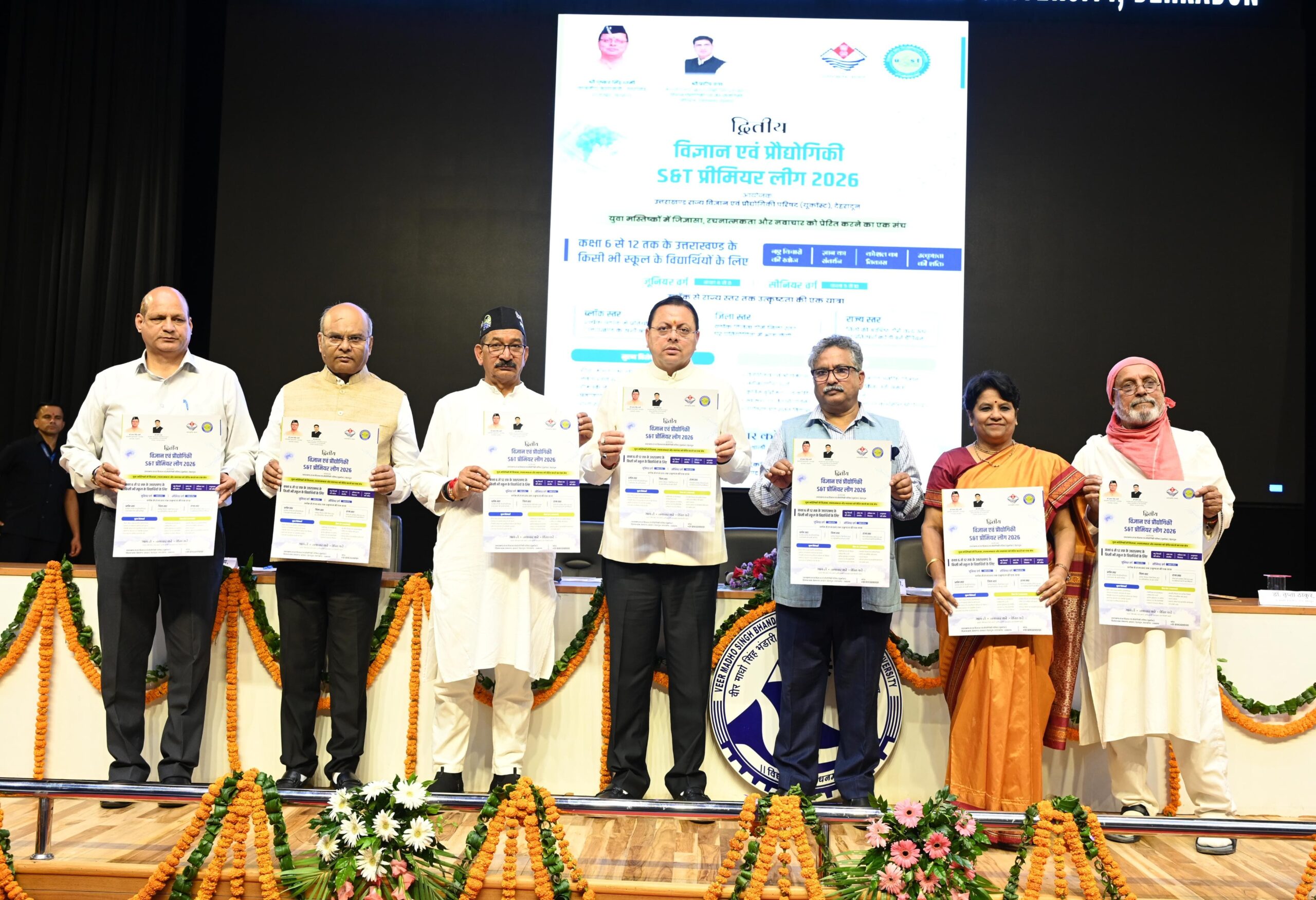
During the programme, CM Dhami unveiled five posters related to science and technology. These included posters for the 7th Dehradun International Science and Technology Festival, Science and Technology Premier League, Seemant Bal Vigyan Congress, Gyanotkarsh and the 21st Uttarakhand State Science Conference.
He also released the fifth annual edition of ‘Vigyan Samprashan’, a magazine focused on popularising science and technology.
Himalayas are the foundation of Uttarakhand’s identity
CM Dhami said the Himalayas are not merely a mountain range but the foundation of Uttarakhand’s identity, culture and existence. Since ancient times, the Himalayas have been the land of meditation and spiritual pursuit for sages, saints and thinkers. Several life-giving rivers, including the Ganga and Yamuna, originate in the Himalayan region.
The Chief Minister said climate change and global warming are among the biggest challenges facing the world, and their impact is increasingly visible in the Himalayan region. Rising pressure on glaciers, the depletion of traditional water sources, extreme rainfall, landslides, forest fires and flash floods are creating new challenges.
He stressed that development activities in the Himalayas must respect the region’s ecological sensitivity and maintain a balance between science, technology, safety and nature.
Himalayan concerns must reach national and global platforms
CM Dhami said climate change does not recognise state or national boundaries. Although Himalayan regions have contributed relatively little to environmental degradation, they may have to bear a disproportionate share of the consequences.
He said the responsibility for addressing climate change must therefore be shared, and the concerns of Himalayan states need to be raised more strongly at national and international forums.
The Chief Minister pointed out that the impact of melting glaciers and stressed water sources extends beyond the mountains, affecting rivers, agriculture, drinking water and the lives of millions of people. Therefore, he said, Himalayan conservation is not merely an environmental issue but a matter directly linked to the future of society.
He added that future generations would not only ask about roads and buildings created during our time, but also about the condition of forests, rivers, clean air and water. “We have to decide today what kind of Uttarakhand we want to leave behind for future generations,” he said.
Development must strike a balance between ecology and economy
The Chief Minister said mountainous regions need better roads, electricity, quality education, healthcare facilities and employment opportunities. However, Uttarakhand’s development model must be designed according to the state’s unique geography and local requirements.
He said the path of Uttarakhand’s development must pass through a balance between ecology and economy.
The state needs a development model where roads are built while forests are protected, employment opportunities grow while rivers remain clean, and tourism expands without compromising the carrying capacity of the mountains.
PM Modi’s ‘Mission LiFE’ highlighted
CM Dhami said Prime Minister Narendra Modi has given the world an effective environmental conservation mantra through ‘Mission LiFE’—Lifestyle for Environment.
He emphasised that environmental protection cannot be achieved through government policies alone. Individual lifestyle changes are equally important.
Saving water and electricity, reducing the use of plastic, maintaining cleanliness, choosing local products and adopting responsible behaviour towards nature can collectively bring about significant change, he said.
Focus on sustainable development of Himalayan regions
The Chief Minister said initiatives such as Namami Gange, the National Mission for Sustaining the Himalayan Ecosystem and the Vibrant Villages Programme are helping accelerate conservation and sustainable development in Himalayan areas.
He said the Uttarakhand government is working with the objective of making the state a model state for Himalayan conservation.
Uttarakhand should not remain limited to highlighting the challenges faced by the Himalayas, he said, but should emerge as a state that provides leadership and solutions to the country. Traditional knowledge must be integrated with modern science and technology to find sustainable solutions to Himalayan challenges.
Himalayan Day Week launched to strengthen public participation
CM Dhami stressed that public participation is crucial for Himalayan conservation. With this objective, the state has initiated the observance of the period from Bugyal Day on September 2 to Himalaya Day on September 9 as ‘Himalaya Day Week’.
He said Himalayan conservation should not remain confined to government programmes and seminars but should evolve into a people’s movement.
The Chief Minister described bugyals as important centres of biodiversity and water resources, forests as protectors of air, water and soil, and rivers as the lifelines of civilisation.
Himalayan conservation linked with prosperity in the hills
CM Dhami said conservation of the Himalayas must go hand in hand with economic prosperity in mountain areas.
He said creating employment in villages, providing markets for local products, promoting the economic empowerment of women, encouraging natural farming and developing eco-friendly tourism can help reduce migration from the hills.
He stressed that Himalayan conservation and prosperity in the mountains are not contradictory but complementary goals.
The state’s forests, bugyals, biodiversity, rivers, traditional knowledge and local products constitute its ecological wealth and can become a major source of economic strength in the future.
Dignitaries present
MLA Kishore Upadhyay, HESCO founder and Padma Bhushan awardee Dr Anil Prakash Joshi, Veer Madho Singh Bhandari Uttarakhand Technical University Vice Chancellor Dr Tripta Thakur, UCOST Director General Prof Durgesh Pant, University Registrar Dr Rajesh Upadhyay, UCOST Joint Director D.P. Uniyal and other dignitaries were present at the programme.