Sri Lankan Officials Study Uttarakhand’s Disaster Management Model
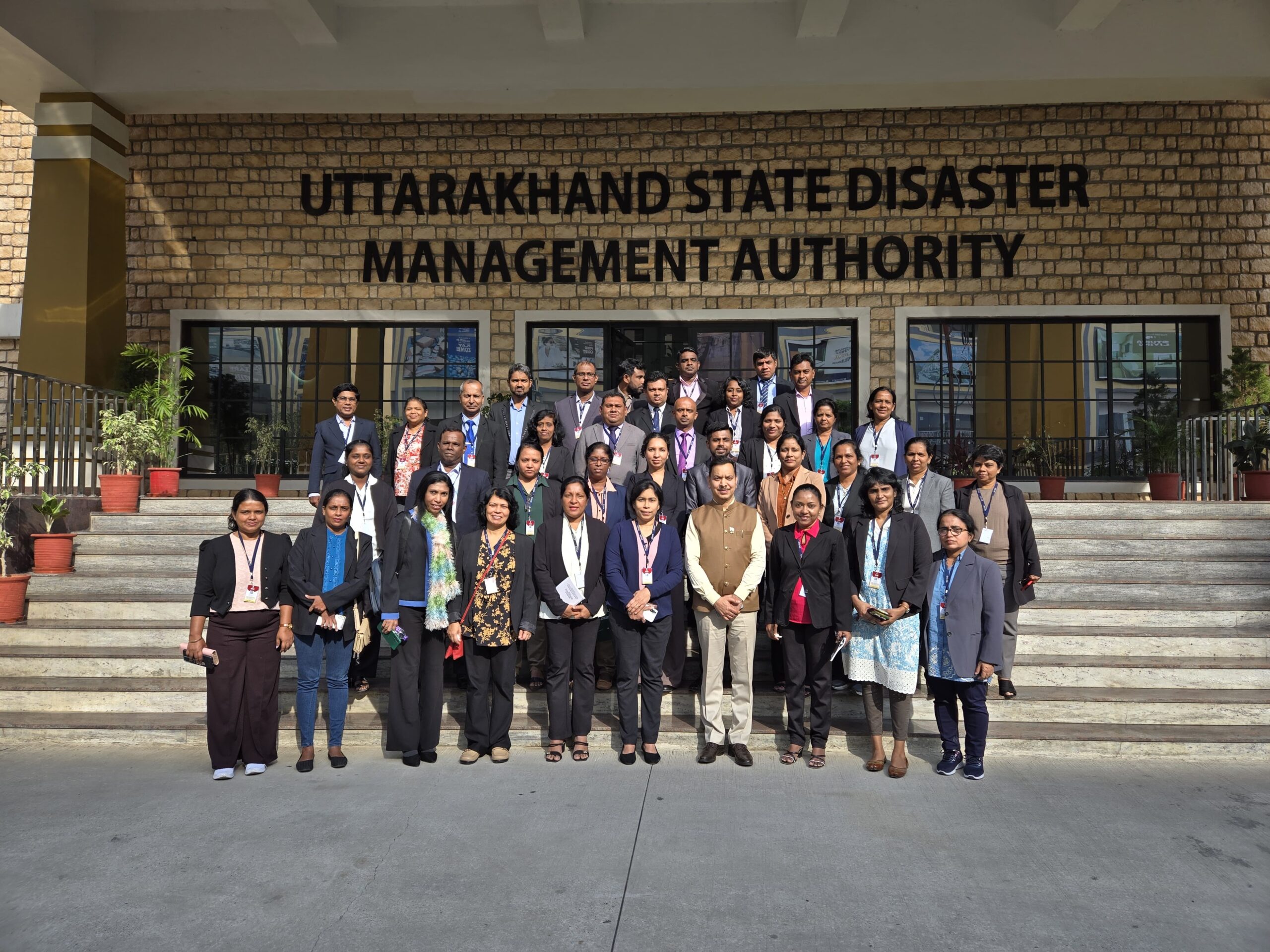
Dehradun, June 1: A delegation of 40 civil service officers from Sri Lanka visited the Uttarakhand State Disaster Management Authority (USDMA) on Monday as part of a Capacity Building Programme on Disaster Management organized under the aegis of the National Centre for Good Governance (NCGG). During the visit, the delegates gained insights into Uttarakhand’s disaster management framework, technological innovations, early warning systems, and community-based disaster risk reduction initiatives.
Welcoming the delegation, Raj Kumar Negi, Additional Chief Executive Officer (Implementation), USDMA, provided a detailed overview of the state’s institutional mechanisms for disaster preparedness, response, and risk reduction. He highlighted the robust systems established in Uttarakhand to ensure swift and effective relief and rescue operations during natural disasters.
Negi explained the functioning of the State Emergency Operations Centre (SEOC) and District Emergency Operations Centres (DEOCs), the disaster alert dissemination process, warning communication systems, and the extensive use of Information and Communication Technology (ICT) in disaster management. He emphasized that local communities play a vital role in disaster preparedness and response, making community participation a cornerstone of Uttarakhand’s disaster management strategy.
He further noted that the state has developed a multi-layered communication network to ensure timely dissemination of weather forecasts and disaster alerts to the last mile, significantly reducing disaster risks in vulnerable regions. Given Uttarakhand’s mountainous terrain and unique geographical challenges, the state has adopted a combination of advanced technology and local expertise to strengthen disaster resilience.
Speaking about weather forecasting and warning mechanisms, Negi informed the delegates that the India Meteorological Department (IMD) collects data through satellite-based observation systems, Doppler Weather Radars, Automatic Weather Stations (AWS), Automatic Rain Gauges (ARG), and advanced weather modeling technologies.
The data is analyzed in real time to generate forecasts at multiple levels, which are particularly crucial for risk management and preparedness in the state’s sensitive mountainous areas.
During the programme, Dr. Shantanu Sarkar, Director of the Uttarakhand Landslide Mitigation and Management Centre (ULMMC), shared details of the scientific initiatives being undertaken to assess, monitor, and mitigate landslide risks across the state.
As Sri Lanka also frequently experiences heavy rainfall and landslides, the visiting officers showed keen interest in Uttarakhand’s landslide management techniques, risk assessment systems, and community-based disaster preparedness models. The delegates engaged in detailed discussions with experts to better understand the technologies and best practices adopted in the state.
Joint Chief Executive Officer of USDMA, Mohammad Obaidullah Ansari, was also present on the occasion.
International Collaboration Strengthens Disaster Management: Vinod Kumar Suman
Secretary, Disaster Management and Rehabilitation, Vinod Kumar Suman, said that such study tours and capacity-building programmes serve as effective platforms for knowledge exchange and institutional learning in the field of disaster management.
He emphasized that sharing experiences and best practices among countries enhances institutional efficiency and helps develop more coordinated and effective approaches to disaster risk reduction. He added that Uttarakhand’s disaster management model and experiences could be valuable for other nations, while global best practices could further strengthen the state’s disaster management systems.
Dr. A.P. Singh, Associate Professor at the National Centre for Good Governance (NCGG), stated that the institution, established by the Government of India, is a premier organization working in the areas of good governance, policy reforms, training, and capacity building.
He informed that NCGG has conducted capacity-building programmes for civil servants from 52 countries and has trained thousands of officers over the years. Under a cooperation agreement with the Government of Sri Lanka, a specialized training programme on disaster management is currently being conducted, as part of which this study visit to Uttarakhand was organized.
The visit is being viewed as a significant step toward strengthening India–Sri Lanka cooperation in disaster management and promoting the exchange of knowledge, expertise, and best practices in disaster risk reduction and resilience building.