CM Pushkar Singh Dhami calls Union Budget 2026–27 a visionary roadmap for Viksit Bharat @2047 and self-reliant Uttarakhand, boosting tourism, green energy, MSMEs and infrastructure.
Nainital (Haldwani):
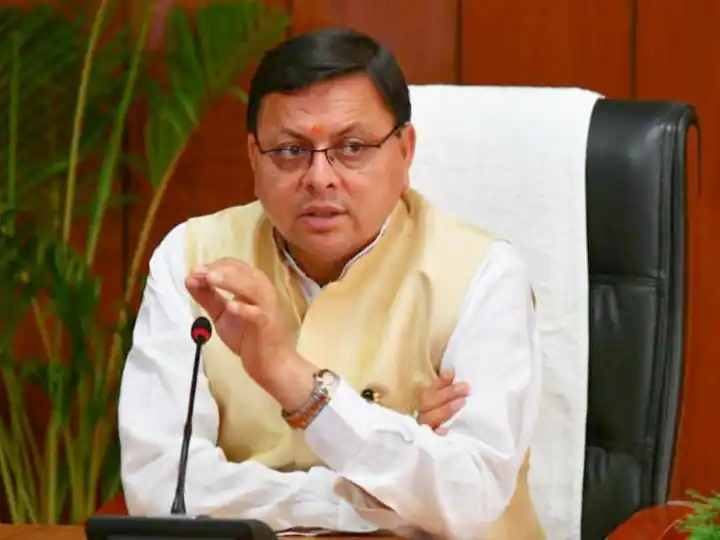
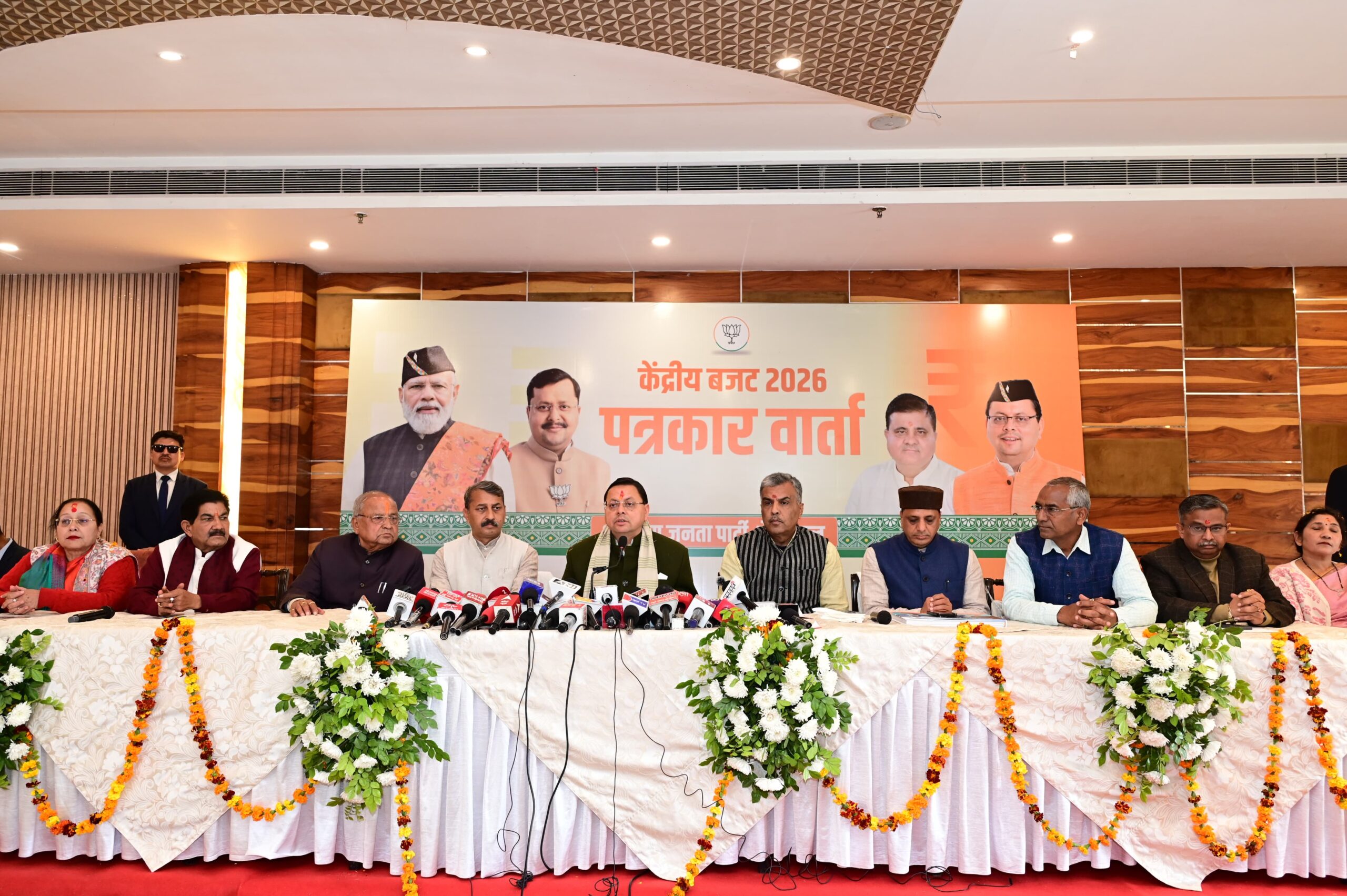
Chief Minister Pushkar Singh Dhami on Wednesday described the Union Budget 2026–27 as a historic, forward-looking and transformative roadmap towards achieving the vision of a “Viksit Bharat @2047” and building a self-reliant Uttarakhand. Addressing a press conference at Hotel Amardeep on Haldwani–Rampur Road during his two-day visit to Nainital district, the Chief Minister said the budget goes far beyond immediate requirements and lays a strong, sustainable foundation for India’s economic, social and strategic growth in the coming decades.
Expressing gratitude to Prime Minister Narendra Modi and Union Finance Minister Nirmala Sitharaman, CM Dhami said the substantial increase in capital expenditure reflects the Union Government’s long-term vision for nation-building. He noted that the budget strengthens India’s economic resilience, strategic autonomy and sovereignty, while reinforcing the resolve of Aatmanirbhar Bharat.
The Chief Minister emphasized that development for the present government is not merely about figures in the budget but about bringing meaningful and positive change in the lives of citizens. He said the budget offers relief and dignity to the middle class, taxpayers and the working population. With innovation, manufacturing and employment generation at its core, the budget is expected to enhance productivity and create sustainable job opportunities, strengthening India’s long-term economic potential.
Highlighting the allocation of over ₹12 lakh crore towards capital expenditure, CM Dhami said the government views infrastructure as a long-term national asset rather than just a short-term necessity. The development of seven new economic corridors, expansion of modern transport networks and logistics infrastructure will boost investment, industrial growth and balanced regional development. Major connectivity projects such as the Varanasi–Haldia Inland Waterway, Delhi–Varanasi and Varanasi–Siliguri high-speed rail corridors will open new avenues for trade, tourism, employment and national integration.
CM Dhami stated that the Union Budget 2026–27 will directly contribute to the inclusive development of Uttarakhand. Special emphasis has been laid on the empowerment of hilly, border and remote regions, along with focused support for villages, women, youth, senior citizens and marginalized sections. He informed that Uttarakhand’s share in central taxes has been fixed at ₹17,414.57 crore for the current year, providing the state with an additional ₹1,841.16 crore in fiscal support.
The Chief Minister further said that the state government’s request for continuation of the “Scheme for Special Assistance to States for Capital Investment” has not only been accepted but significantly enhanced. The allocation under this scheme has been increased from the revised estimate of ₹1.44 lakh crore to ₹1.85 lakh crore, marking an additional boost of ₹41,000 crore to strengthen state-level infrastructure development.
Referring to women empowerment initiatives, CM Dhami said that building on the success of the Lakhpati Didi Yojana, the budget provides for credit-linked livelihood opportunities to encourage women entrepreneurship, which will further strengthen the economic independence of women in Uttarakhand.
He highlighted that Uttarakhand has received a record allocation of ₹4,769 crore in the railway sector — nearly 26 times higher compared to the 2009–2014 period. Rail projects worth ₹39,491 crore are currently underway in the state. The Rishikesh–Karnprayag rail project is nearing completion, while 11 railway stations are being redeveloped under the Amrit Station Scheme. The state has achieved 100% railway electrification, strengthened safety through 54 Kavach systems, and improved connectivity with 106 flyovers and underpasses, along with the operation of three Vande Bharat Express and one Amrit Bharat Express train services.
The Chief Minister said the tourism sector has received special impetus in the Union Budget, which will generate large-scale employment opportunities in Uttarakhand. A strong focus on green energy and the green economy has been incorporated to ensure sustainable development and long-term environmental benefits for the Himalayan state. He added that enhanced support to AYUSH, pharmaceuticals, khadi, handloom and MSMEs will strengthen the rural economy and promote local entrepreneurship.
CM Dhami also underlined that the budget places strong emphasis on women’s safety, education and empowerment, including provisions for women’s hostels in every district, which will support working women and students. Measures aimed at improving Ease of Doing Business and promoting trust-based governance will further boost investments, employment generation and public participation.
He said the Union Budget 2026–27 empowers farmers, creates opportunities for youth, promotes women-led development, strengthens hill states, and accelerates India’s journey towards becoming a developed and self-reliant nation. The three core pillars of the budget — balanced and inclusive growth, capacity building of marginalized sections, and the vision of “Sabka Saath, Sabka Vikas” — provide a clear roadmap for the holistic development of border areas, rural regions, women, youth, senior citizens and children.
The Chief Minister noted that focused development of Tier-2 and Tier-3 cities will particularly benefit Dehradun, Haridwar and Haldwani. He added that Uttarakhand’s interests have been duly safeguarded in line with the recommendations of the 16th Finance Commission. Several proposals submitted by the state government have been directly and indirectly reflected in the Union Budget, reinforcing the spirit of cooperative federalism.
Concluding, CM Dhami said that the Union Budget 2026–27 will play a pivotal role in elevating Uttarakhand’s growth trajectory across employment, investment, exports, skill development and urban infrastructure, and will emerge as a milestone in ensuring inclusive, balanced and sustainable development of the state.